

Why Understanding Your Story Might Matter More Than Finding the Right Label: A Perinatal Psychologist's Guide to Formulation
Many people arrive in therapy hoping to finally understand what is wrong with them.
By the time they seek support, they have often spent months trying to make sense of what they are experiencing. They may have completed online questionnaires, searched endlessly for answers, listened to podcasts, read books, or spoken to healthcare professionals. Some have received diagnoses that feel validating and helpful. Others are left feeling that, although a label describes what they are experiencing, it doesn't really explain it.
This is particularly common during pregnancy and early parenthood. Someone may recognise that they are experiencing anxiety, low mood, intrusive thoughts, birth trauma, difficulties bonding with their baby, or a profound loss of confidence. However, understanding what something is does not necessarily help us understand why it is happening.
As a perinatal psychologist, I often find that the question people most want answered is not "What diagnosis do I have?" but "Why am I struggling in this way?"
This is where formulation becomes important.
Formulation sits at the heart of clinical psychology. While diagnoses aim to categorise patterns of symptoms, formulation aims to understand the individual person experiencing them. It is a way of bringing together the different pieces of somebody's story in order to develop a meaningful explanation of how their difficulties may have developed, what might be maintaining them, and what might help.
In many ways, formulation is the process of moving beyond labels and towards understanding.
What Is a Formulation?
A formulation is sometimes described as a psychological map.
When people are struggling, there are usually many different factors involved. Current circumstances, previous experiences, personality, relationships, coping strategies, physical health, stress, sleep, social support, and significant life events all interact with one another in complex ways.
A formulation attempts to make sense of these different influences and how they fit together.
Rather than asking whether somebody meets criteria for a particular diagnosis, formulation asks questions such as:
Why has this difficulty emerged now?
What experiences may have contributed to it?
What makes this particular person vulnerable to this particular difficulty?
What keeps the problem going?
What strengths and resources can be drawn upon?
What might help?
Importantly, formulations are individual. Two people can have very similar symptoms but entirely different formulations.
For example, two women may both experience significant anxiety during pregnancy. One may be navigating pregnancy after multiple losses and finding it difficult to trust that things will be okay. The other may have a longstanding tendency towards perfectionism and feel an overwhelming sense of responsibility for preventing anything bad from happening. Although the anxiety may look similar on the surface, the factors driving and maintaining it may be quite different.
This is one of the reasons why psychological therapy is rarely as simple as applying the same intervention to everyone with the same diagnosis.
Why the Perinatal Period Is So Important for Formulation
The transition to parenthood is one of the most significant psychological transitions many people will ever experience. Pregnancy, birth, and early parenthood involve changes in identity, relationships, responsibilities, daily routines, sleep, physical health, and future expectations. For some people, these changes occur alongside fertility treatment, previous losses, traumatic births, financial pressures, relationship difficulties, or a lack of social support.
Even positive experiences can be emotionally demanding. Becoming a parent often brings a heightened awareness of vulnerability, responsibility, and uncertainty. It can prompt reflection on our own childhoods, our relationships, and the kind of parent we hope to become.
When difficulties emerge during this period, it is tempting to search for a single explanation. However, most psychological difficulties are rarely caused by one thing alone. A formulation helps us understand how multiple factors interact.
For example, someone experiencing intense anxiety after the birth of their baby may be coping with sleep deprivation, a traumatic birth experience, a tendency towards self-criticism, a strong sense of responsibility for other people's wellbeing, and a lack of practical support. None of these factors alone fully explains the difficulty. Together, however, they begin to tell a meaningful story.
What Can CBT Contribute to a Formulation?
One of the most useful aspects of Cognitive Behavioural Therapy is its focus on understanding the patterns that maintain distress.
Many people assume that CBT is primarily concerned with changing negative thoughts. Modern CBT is often much more interested in understanding the processes that keep difficulties going. For example, a parent who becomes worried about their baby's health may begin checking constantly for signs of illness, searching online for reassurance, monitoring their baby's behaviour closely, and seeking repeated confirmation from others that everything is okay. All of these responses are understandable. Most begin as attempts to reduce anxiety and protect the baby.
However, they can also create a cycle in which anxiety remains highly active. The more the parent checks and seeks reassurance, the less opportunity they have to learn that uncertainty can be tolerated and that feared outcomes are often less likely than they imagine. From a CBT perspective, formulation helps identify these maintaining cycles. Rather than asking only why anxiety started, it asks what might be keeping it going now.
The same principle can be applied to many perinatal difficulties. Avoidance may maintain birth-related fears. Withdrawal may maintain low mood. Attempts to suppress intrusive thoughts may make those thoughts feel more significant and threatening. A CBT formulation therefore helps identify the patterns that therapy might usefully target.
What Does a Compassion-Focused Formulation Add?
Compassion-Focused Therapy brings a slightly different perspective. Where CBT often asks what is maintaining a difficulty, Compassion-Focused Therapy asks what function a particular response may be serving. Many parents are highly self-critical. They tell themselves that they should be coping better, enjoying parenthood more, feeling more grateful, or managing without support.
When we look at these patterns through a compassion-focused lens, something interesting often emerges. Self-criticism is rarely random. For many people, it developed as an attempt to motivate themselves, avoid mistakes, gain approval, or prevent rejection. Although it may now be causing distress, it often began as a strategy for coping with difficult circumstances.
A compassion-focused formulation helps us understand these protective intentions. Rather than seeing anxiety, perfectionism, people-pleasing, or self-criticism as evidence that something is wrong, we begin asking what these responses may have been trying to achieve. This shift can be enormously relieving for parents who have spent years blaming themselves for struggling.
What Role Do Attachment and Relationships Play?
One of the things formulation helps us appreciate is that people do not develop in isolation. Attachment theory suggests that early relationships help shape our expectations about ourselves and other people. Through repeated experiences, we develop beliefs about whether others can be relied upon, whether our needs matter, whether it is safe to seek support, and how emotions are handled within relationships.
These expectations are rarely conscious. Most of us are not aware of carrying them around. However, becoming a parent often activates them. Someone who learned early in life that they needed to cope alone may find it difficult to ask for help after having a baby. Someone who experienced inconsistency in relationships may find the uncertainty of pregnancy particularly difficult. Someone who felt responsible for managing other people's emotions may become overwhelmed by the constant demands of caregiving.
An attachment-informed formulation is not about blaming parents or searching for childhood causes of every difficulty. Rather, it recognises that our relational histories help shape how we experience the challenges of parenthood. Parenthood itself is also deeply relational. Difficulties affect partners, babies, families, and support networks. In turn, those relationships influence how difficulties are maintained or resolved. A good formulation therefore considers not only what is happening within a person but also what is happening between people.
What Does Neuroscience Add to Formulation?
One of the most common things people say in therapy is: "I know this doesn't make sense, but I still feel it." A parent may know logically that their baby is safe and yet continue to experience overwhelming anxiety. Someone may recognise that they are not failing and still feel intense shame. Neuroscience helps us understand why.
The brain learns through experience. Emotional learning is not stored only in conscious, verbal memories. It is also reflected in physiological responses, emotional expectations, habits, and patterns of nervous system activation. This means that insight alone is not always enough. Understanding something intellectually and feeling it emotionally are not necessarily the same thing.
A neuroscience-informed formulation helps explain why change often requires more than simply thinking differently. It may involve creating new experiences of safety, support, self-compassion, or connection that gradually allow the nervous system to update old expectations. This can be particularly relevant during the perinatal period, when pregnancy, birth, sleep deprivation, hormonal changes, and caring for a vulnerable baby place considerable demands on the nervous system.
Why Formulation Matters More Than Advice
One of the reasons I value formulation so highly is that it helps us avoid rushing prematurely to solutions. People often seek advice when they are struggling. Advice can certainly be useful. However, before deciding what might help, we need to understand the nature of the difficulty we are trying to address.
Two people may both be anxious, but one may benefit from reducing reassurance-seeking while another may need support processing trauma. One parent may need help developing self-compassion, while another may need practical support and greater connection with others.
Without formulation, it is easy to offer solutions that make sense in theory but miss the complexity of the individual experience. Formulation provides the foundation upon which meaningful therapeutic work is built.
From "What's Wrong With Me?" to "What Makes Sense?"
Perhaps the most valuable thing formulation offers is a shift in perspective. Many people arrive in therapy believing that their distress is evidence that something is wrong with them. They see anxiety, low mood, self-criticism, trauma responses, or relationship difficulties as signs that they are failing. Formulation invites a different question. Rather than asking what is wrong, it asks what makes sense.
Given your experiences, your relationships, your personality, your coping strategies, your responsibilities, and the circumstances you are living through, what makes sense about what you are experiencing?
This does not mean that difficulties become easy. Nor does it mean that painful experiences are inevitable. What it does mean is that distress becomes understandable. And when something becomes understandable, it often becomes easier to approach with curiosity, compassion, and hope.
In my experience, that is often where meaningful change begins. Not with finding the perfect label, but with developing a richer understanding of your own story.

Why Perinatal Anxiety Is Not Really About Worrying
What modern psychological research can teach us about anxiety during pregnancy and early parenthood
One of the things that can feel particularly frustrating about perinatal anxiety is that it often persists despite enormous effort.
Many parents I meet have spent months trying to manage their anxiety before seeking support. They have read books, listened to podcasts, spoken to friends, attended antenatal classes, searched online, sought reassurance from healthcare professionals, and thought carefully about every decision they are making.
Yet despite all of this effort, the anxiety remains. Sometimes it even seems to become stronger. This can leave people feeling confused. If they are doing everything possible to keep themselves and their baby safe, why does their mind still feel so preoccupied with danger?
Traditional explanations often suggest that anxiety occurs because people are worrying too much. Modern cognitive models offer a different perspective. These models suggest that anxiety is often maintained not simply by the presence of worry, but by the ways in which we respond to uncertainty, perceived threat, and difficult emotions.
Understanding this distinction can be particularly helpful during pregnancy and early parenthood, where uncertainty is not only unavoidable but built into the experience itself.
Anxiety Makes Sense When Something Matters
One of the most important ideas within contemporary anxiety research is that anxiety is usually attached to something meaningful.
People do not generally become highly anxious about things they do not care about.
During pregnancy and early parenthood, the stakes often feel extraordinarily high. Many parents find themselves responsible for something that feels both deeply precious and deeply vulnerable.
It therefore makes sense that concerns emerge.
Questions such as:
What if something happens to my baby?
What if I miss an important sign?
What if I make the wrong decision?
What if I cannot cope?
What if something goes wrong during the birth?
are not irrational questions.
In many ways, they reflect the reality that parenthood involves genuine responsibility and genuine uncertainty. The challenge is not that these thoughts occur. The challenge is what happens next.
How the Brain Becomes Organised Around Threat
One of the core ideas in cognitive models of anxiety is that anxiety changes the way attention operates.
When something feels threatening, our attention naturally becomes drawn towards it. From an evolutionary perspective, this is highly adaptive. If there is a danger present, noticing it quickly improves our chances of responding effectively.
However, anxiety can create a situation in which attention becomes increasingly organised around detecting potential threats.
Many parents notice that once they become concerned about a particular issue, it begins to dominate their awareness.. A parent worried about fetal movements may find themselves monitoring every sensation throughout the day. A parent worried about illness may become acutely aware of every change in their baby's behaviour. A parent worried about their own mental health may find themselves constantly scanning for evidence that they are not coping.
Importantly, this does not mean the threat has necessarily increased. Rather, the brain has become more skilled at detecting information that appears relevant to the concern. Over time, this selective attention can create the impression that danger is everywhere.
Why Reassurance Feels Helpful But Rarely Solves the Problem
Most anxious parents seek reassurance. This is entirely understandable. When we feel uncertain, it is natural to seek information, advice, or confirmation from people we trust. Many parents find themselves repeatedly:
Googling symptoms
Comparing experiences with other parents
Asking partners for reassurance
Seeking confirmation from healthcare professionals
Reading parenting forums
The difficulty is that reassurance often provides only temporary relief.
Research suggests that reassurance can unintentionally strengthen the belief that certainty is necessary before we can relax.
For example, imagine a parent who becomes worried that their baby's feeding pattern is unusual. They search online and eventually find information that reassures them. Their anxiety decreases. The brain learns an important lesson: "The reason I feel better is because I found certainty." The next time uncertainty appears, the urge to seek reassurance becomes even stronger. The problem is not reassurance itself. The problem is becoming dependent upon reassurance as the primary way of managing uncertainty.
Safety Behaviours: When Protection Starts Maintaining Anxiety
Another important concept within modern anxiety models is the idea of safety behaviours. Safety behaviours are actions designed to prevent feared outcomes. During pregnancy and parenthood these often emerge from a very understandable desire to protect.
Examples might include repeatedly checking a baby's breathing, avoiding situations perceived as risky, monitoring symptoms throughout the day, carrying out extensive research before making decisions, or seeking constant reassurance about a child's wellbeing.
The challenge is that safety behaviours make it difficult for the brain to update its beliefs… Imagine a parent who checks their baby's breathing ten times every night. Each morning, the baby is safe. The parent naturally concludes that checking was important.
What they never get the opportunity to discover is whether the baby would also have been safe if they had checked only once. The brain therefore continues to attribute safety to the behaviour rather than recognising that the feared outcome was unlikely in the first place. This is one reason anxiety can become surprisingly persistent despite considerable effort to manage it.
The Particular Challenge of Parenthood: Living With Uncertainty
Perhaps the most useful concept for understanding perinatal anxiety is intolerance of uncertainty. Research consistently suggests that many anxiety difficulties are maintained by the belief that uncertainty is dangerous, intolerable, or must be resolved before it is possible to feel calm. The difficulty is that parenthood offers very few opportunities for complete certainty. There is no test that can guarantee a pregnancy will proceed exactly as hoped. No amount of checking can completely eliminate the possibility of illness. No parenting decision comes with absolute certainty about future outcomes. This can feel deeply uncomfortable. Particularly for people who are conscientious, thoughtful, and invested in doing the best for their children.
One of the most important shifts in therapy often involves moving away from the goal of achieving certainty and towards developing confidence in one's ability to tolerate uncertainty. These are not the same thing. The first asks: "How can I know for sure?" The second asks: "How can I live well even when I cannot know for sure?"
Why Intrusive Thoughts Feel So Convincing
Many parents become alarmed by intrusive thoughts. They may experience sudden images of accidental harm, illness, injury, or catastrophe and wonder what these thoughts mean. One of the most consistent findings within anxiety research is that intrusive thoughts are common. The difference is often not whether people experience them, but how they interpret them.
An anxious parent may assume that a distressing thought is important because it feels distressing. The mind begins paying more attention to the thought, monitoring for similar thoughts, and attempting to prevent the feared outcome. Ironically, this increased attention often makes the thoughts feel more frequent and more significant.
Understanding that intrusive thoughts are a normal feature of human cognition can help loosen their hold. Thoughts are not predictions. They are not intentions. And they are not reliable indicators of what will happen in the future.
A Different Way of Thinking About Recovery
One reason many parents become discouraged is that they view recovery as the absence of anxiety. This is an understandable goal, but it may not be a realistic one. Anxiety is part of being human, and some degree of anxiety is an inevitable consequence of loving someone deeply.
The goal of therapy is therefore not usually to eliminate anxiety altogether. Instead, it is to reduce the processes that keep anxiety stuck. To become less reliant on reassurance. To recognise when attention has become overly focused on threat. To understand the role of safety behaviours. To develop a different relationship with uncertainty. Most importantly, it is to build confidence that difficult thoughts and feelings can be experienced without needing to solve them immediately.
Moving From Certainty to Trust
Many parents begin therapy hoping to feel certain. What they often discover is something more useful. Not certainty, but trust. Trust in their ability to make thoughtful decisions, in their capacity to cope with uncertainty. Trust that they can respond to challenges as they arise, and that being a good parent does not require constant vigilance or perfect decision-making. Parenthood will probably always involve uncertainty. The question is not whether uncertainty can be eliminated but whether it can become something we carry with a little more flexibility, self-compassion, and confidence than before.

The Ghosts in the Nursery: Why Becoming a Parent Can Bring the Past Into the Present
Many parents are surprised by how much becoming a parent makes them think about their own childhood.
Sometimes this happens quite consciously. You might find yourself remembering things your parents did that you'd like to repeat, or reflecting on experiences that shaped the kind of parent you hope to become.
At other times, it is less obvious.
You might notice yourself feeling unexpectedly upset when your baby cries. You may find yourself worrying constantly about getting things wrong, feeling unusually hurt when your toddler rejects your comfort, or becoming overwhelmed by feelings that seem bigger than the situation in front of you.
For some parents, these reactions can be confusing. They may think:
"Why am I finding this so difficult?"
"Why does this affect me so much?"
"Where is this reaction coming from?"
Questions like these sit at the heart of one of the most influential ideas in infant mental health: the ghosts in the nursery.
Although the phrase may sound dramatic, the underlying idea is surprisingly gentle and compassionate. It suggests that when we become parents, our own childhood experiences often become more emotionally relevant again. Not because we are consciously dwelling on the past, but because caring for a child activates many of the same systems in the brain and body that were shaped in our earliest relationships.
Understanding this can help us make sense of why parenthood is not simply about raising a child. It is also, in many ways, about revisiting our own experiences of being cared for.
The Original Idea: Selma Fraiberg and the Ghosts in the Nursery
The phrase "ghosts in the nursery" was introduced by child psychiatrist Selma Fraiberg and her colleagues in the 1970s.
Working with vulnerable families and young children, Fraiberg noticed something interesting. Many parents deeply loved their children and wanted to provide nurturing, responsive care. Yet they sometimes found themselves reacting in ways that seemed difficult to understand.
A parent who had felt emotionally neglected as a child might struggle to respond consistently to their baby's needs.
A parent who had grown up in an unpredictable household might become highly anxious whenever their child was distressed.
A parent who had experienced criticism or rejection might be particularly sensitive to normal developmental behaviours such as tantrums, clinginess, or defiance.
Fraiberg suggested that unresolved aspects of the parents' own childhood experiences were influencing their relationships with their children.
The "ghosts" were not simply memories. They were emotional experiences that continued to shape expectations, reactions, and relationships long after the original events had passed.
What made Fraiberg's work so powerful was that she viewed these parents with enormous compassion. She did not see them as deliberately repeating harmful patterns. Instead, she understood them as people carrying experiences that had never been fully recognised, understood, or processed.
Why Parenthood Activates Old Experiences
Attachment theory helps us understand why parenthood can be such a powerful trigger for reflection and emotional change.
As children, we develop expectations about ourselves and other people through repeated interactions with caregivers. These expectations are sometimes called "internal working models."
Through thousands of everyday experiences, we begin to learn things such as:
Are other people available when I need them?
What happens when I am distressed?
Is it safe to depend on others?
Are my emotions welcome?
Am I worthy of care and attention?
Most of the time, these expectations operate quietly in the background. We are rarely aware of them.
However, when we become parents, many of the same attachment systems become activated again.
We are suddenly responsible for responding to distress, providing comfort, managing dependency, and helping another human being regulate their emotions.
It is perhaps unsurprising that this can bring our own experiences of comfort, care, rejection, criticism, safety, or insecurity closer to the surface.
What Neuroscience Adds to the Story
Fraiberg developed her ideas long before modern neuroscience became available. Interestingly, many contemporary findings support her observations.
One important finding is that not all memories are stored in the same way.
When we think about memory, we often imagine autobiographical memories—the stories we can consciously remember and describe.
But much of our early relational learning occurs before language develops.
Experiences from infancy and early childhood are often stored as what psychologists call implicit memories.
Implicit memories influence how we feel, what we expect, and how we respond, even when we cannot consciously recall the experiences that shaped them.
For example, a parent may have no specific memory of being criticised as a child. Yet they may experience intense feelings of failure whenever they perceive themselves to be getting parenting "wrong."
Similarly, someone who experienced inconsistency in early relationships may find uncertainty particularly difficult to tolerate once they become responsible for a baby.
In this sense, the brain does not simply store facts about the past. It stores expectations about relationships, safety, threat, and connection.
Parenthood often brings those expectations into sharper focus.
When Your Child Becomes a Trigger
One of the most challenging aspects of parenting is that children naturally activate our emotional systems.
This is not because children are trying to trigger us. It is simply because caregiving is emotionally demanding.
A baby's crying activates powerful caregiving instincts.
A toddler's tantrum can evoke feelings of helplessness.
A child's rejection may touch on fears of not being loved or appreciated.
A teenager's growing independence can stir anxieties about separation and loss.
Most of the time these experiences are manageable.
However, if a situation resonates with unresolved aspects of our own history, our reactions can feel much bigger than we expect.
Parents often describe feeling as though they are responding to two situations at once: the child in front of them and something older that they cannot quite put into words.
This does not mean that every strong reaction is evidence of trauma. Nor does it mean that every parenting difficulty originates in childhood.
It simply means that parenthood can sometimes illuminate emotional patterns that were previously less visible.
The Ghosts Are Not Always Traumatic
One common misunderstanding is that the ghosts in the nursery only apply to people who have experienced significant trauma.
This is not the case.
Sometimes the experiences that continue to influence us are subtle and cumulative rather than dramatic.
Perhaps emotions were rarely discussed in your family.
Perhaps achievement was valued more than vulnerability.
Perhaps you learned that other people's needs mattered more than your own.
Perhaps there was love and care, but little space for anger, sadness, or fear.
Children adapt remarkably well to the environments they grow up in. They develop strategies that help them maintain connection and safety.
The difficulty is that strategies that were useful in one context may become less helpful in another.
The perfectionism that earned praise at school may become exhausting when applied to parenting.
The emotional independence that protected against disappointment may make it difficult to ask for support.
The hypervigilance that once helped someone navigate an unpredictable environment may become anxiety when caring for a child.
The Role of Self-Compassion
One of the most hopeful developments in psychology over recent decades has been the growing understanding of self-compassion.
Many parents notice that becoming a parent brings an increase in self-criticism.
They find themselves holding impossibly high standards and feeling guilty whenever they fall short.
Yet research consistently shows that self-criticism tends to increase distress, whereas self-compassion is associated with greater emotional resilience, wellbeing, and parenting confidence.
Understanding the ghosts in the nursery is not about blaming ourselves or our parents.
It is about becoming curious.
Instead of asking:
"What's wrong with me?"
we might ask:
"What might this reaction be trying to tell me?"
or
"Does this feeling remind me of anything familiar?"
Curiosity creates space for understanding. Understanding creates space for choice.
The Angels in the Nursery
Fortunately, Fraiberg's ghosts are only part of the story.
Researchers later introduced the idea of "angels in the nursery"—the positive relational experiences that continue to influence us throughout life.
These may be memories of a parent, grandparent, teacher, friend, neighbour, or mentor who helped us feel understood, valued, or safe.
Just as difficult experiences can shape expectations, positive experiences can become internal resources.
Many parents discover that they carry not only wounds from the past, but also examples of kindness, connection, humour, patience, and care.
These experiences matter too.
They can become important foundations for the relationships we build with our own children.
Moving From Repetition to Reflection
One of the most important findings from attachment research is that our childhood experiences do not determine our future.
The strongest predictor of secure parenting is not having had a perfect childhood.
It is having developed the capacity to reflect on our experiences and make sense of them.
Psychologists sometimes refer to this as reflective functioning or mentalisation.
It is the ability to step back and think about our own thoughts, feelings, and reactions, as well as those of our child.
When parents can do this, the influence of the ghosts often begins to loosen.
Instead of automatically repeating old patterns, there is space to respond differently.
Not perfectly.
But thoughtfully.
A Different Way of Thinking About Parenthood
Perhaps one of the reasons the idea of ghosts in the nursery continues to resonate is that it offers a compassionate explanation for experiences that many parents find confusing.
It helps us understand why parenthood can feel unexpectedly emotional.
Why certain situations affect us more than we expect.
Why old worries, fears, or vulnerabilities sometimes reappear during pregnancy, birth, or early parenthood.
Most importantly, it reminds us that these experiences are not signs of failure.
They are often signs that becoming a parent has touched something important.
The task is not to eliminate every ghost.
The task is to become curious about them.
Because when we understand where our reactions come from, we are often better able to decide what we want to do with them.
And that creates the possibility of something that lies at the heart of both attachment theory and parent-infant psychotherapy: not repeating the past, but understanding it well enough that we can respond differently in the present.

Why Parenting Feels So Overwhelming: Understanding Your Emotional Systems
How our emotional systems work in the early days of parenting
Becoming a parent can stir up huge emotions—love, worry, exhaustion, joy, self-doubt—all in the same hour. If you’re feeling overwhelmed or hard on yourself, you're not alone. Compassion-Focused Therapy (CFT) can help make sense of what’s going on inside, especially during the perinatal period (pregnancy, birth, and the early months and years with baby).
CFT talks about three systems we all have that shape how we feel: threat, drive, and soothe. Each one features unique biomarkers, and link to particular emotions and behaviours. Research suggests that we tend to do best in both our physical and mental health when these three systems are in balance.

1. The Threat System: Always on Guard
This part of us is always on the lookout for danger. It’s what kept our ancestors alive and helps us spot when something’s wrong. But it also reacts to emotional threats; like feeling judged, not good enough, or worrying we’re messing up as parents.
If we’ve had tough experiences in the past (like being criticised a lot, feeling unsafe, or not getting the support we needed) our threat system might be more sensitised. Add in sleep deprivation, tricky births, or pressure to “enjoy every moment,” and it can feel like our brain is stuck on high alert.
Many parents find their inner voice turns harsh. “Why can’t I cope?” “Other parents are doing better.” This kind of self-criticism keeps the threat system firing, which can lead to anxiety, shame, or shutdown.
2. The Drive System: Survival through Striving
Our drive system helps us to get things done. It’s the part of us that prepares for baby, reads all the books, and powers through even when we’re running on empty. For lots of people, especially if love or safety felt like something that had to be earned growing up, the drive system becomes a way to cope and feel in control.
This isn’t bad.. Drive can be amazing. But if it’s always running alongside a busy threat system, it can become exhausting. We might feel like we have to be the perfect parent, or keep busy to avoid feelings of failure or fear. It can become a loop: push harder, crash, feel awful, then push again.
3. The Soothing System: The Missing Piece
This system helps us feel safe, calm, and connected - not because we’ve achieved something, but just because we’re human and we matter. It’s about rest, warmth, comfort, and self-kindness.
For many of us, especially if we have at times not felt safe or soothed in the past, this system can be smaller than the others. But the good news is: we can grow it. Moments of self-kindness (for more, see my blog on the ladder of self-compassion), connection with others, and therapy can help.
Why this matters
When we start to understand how these systems work, we can begin to be kinder to ourselves. Parenting is full-on. We don’t need to be perfect. Building our soothing system isn’t lazy or selfish, it’s what helps us show up for ourselves and for baby with warmth and care.
And so, the question so often on my mind…
How are your systems looking? If we were to draw your own three circles (like the ones above), what sizes would they each be? What might you need to rebalance them?
Again, here’s the link to the ‘ladder of compassion’ article.

Navigating Perinatal Mood Difficulties: A Brief Self-Help Guide
Understanding Mood Difficulties in the Perinatal Period
Becoming a parent is one of life’s biggest transformations—beautiful, intense, and sometimes overwhelming. If you’re feeling anxious, low, or lost in self-doubt, you’re not alone. Many parents experience emotional struggles as they adjust, and it’s not a reflection of how much you love your baby or how good a parent you are.
Cognitive Behavioural Therapy (CBT) and Compassion-Focused Therapy (CFT) offer powerful ways to understand and shift unhelpful patterns of thinking and behaviour, helping us respond to ourselves with greater kindness and connection.
But healing is also deeply relational. Our experiences of being parented, our past relationships, and the way we’ve learned to cope with emotions all shape how we experience early parenthood. Let’s explore how to move toward self-compassion and deeper connection with both yourself and your baby.
1. The Nervous System and Emotional Regulation
Your nervous system plays a key role in how you respond to stress. When we feel safe and connected, our body is in a regulated state. But when we feel overwhelmed, our nervous system can go into fight, flight, freeze mode.
- Fight/Flight: Anxiety, panic, frustration, restlessness.
- Freeze: Feeling numb, stuck, disconnected. Exhaustion, withdrawal, depression.
💡 Exercise: Take a moment to notice your body. What state do you feel in right now? Where do you feel tension or ease? Try taking three slow, deep breaths and notice any changes.
2. The Window of Tolerance: Finding Your Balance
The window of tolerance describes the emotional zone where we feel safe and able to cope (the middle zone in the image below). Stress can push us outside this window, leading to dysregulation. The upper ‘red’ zone, represents fight/flight, and the lower ‘blue’ zone represents freeze.
If we have experienced lots of stress over time, our bodies learn that we need the red and blue zones so they grow (and our WoT shrinks). We can widen our WoT by noticing when we are slipping into the blue and the red zones, and bringing ourselves back using soothing or energising practices…
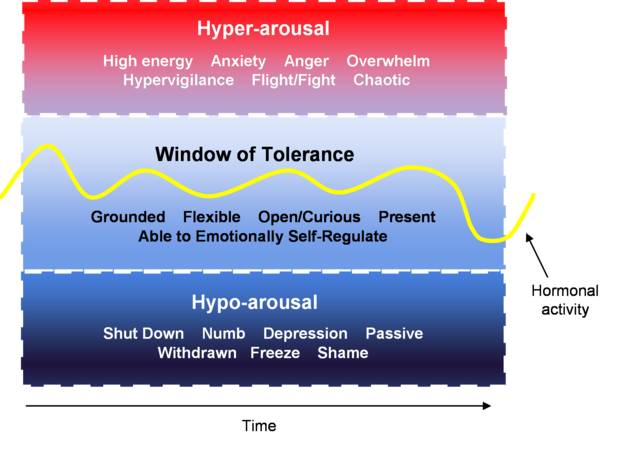
Image Source: Psychology Today
Expanding Your Window of Tolerance
- Soothing Strategies (use when slipping into the red zone): Gentle breathing, mindfulness practices, noticing and releasing tension in the body.
- Energising Strategies (use when slipping into the blue zone): Standing up, moving the body, sensory grounding (really attending to 5 things you can see, hear, smell, taste, touch)
💡 Exercise: Think of one small action that helps you to soothe and energise yourself. Can you commit to trying it today?
3. Attachment, Trauma, and Parenthood
Our early experiences with caregivers can shape how we relate to ourselves and others. If we experienced criticism, neglect, or unpredictability, we may develop self-doubt or struggle with self-soothing in adulthood.
Breaking the Cycle
- Recognising Old Patterns: Notice if your self-criticism echoes past voices.
- Compassionate Reparenting: Starting to build imagery of offering yourself the care you needed as a child.
- Secure Attachment with Your Baby: Focus on moments of connection rather than perfection.
💡 Exercise: Imagine yourself as a child. What words of comfort do you wish you had heard? Try saying them to yourself now.
4. The CBT Model: Thoughts, Feelings, and Behaviours
CBT helps us understand how our thoughts, emotions, and actions are linked. Unhelpful thoughts can fuel difficult emotions and lead to coping behaviours that keep us stuck.

Image source: Get.gg
Common Patterns in the Perinatal Period:
- Thoughts: “I’m a bad parent.” → Feelings: Guilt, shame → Behaviours: Withdrawing from support.
- Thoughts: “I should be enjoying this more.” → Feelings: Anxiety → Behaviours: Pushing through exhaustion.
- Thoughts: “Everyone else is coping better.” → Feelings: Loneliness → Behaviours: Avoiding social contact.
💡 Exercise: Write down a self-critical thought. Now challenge it: Is it a fact or an assumption? What would a kind friend say instead?
5. Tools for Managing Thoughts, Feelings, and Behaviours
Managing Thoughts
- Self-Compassionate Reframing: Replace self-criticism with kinder perspectives.
- Thought Diffusion: Picture your thoughts as leaves floating down a stream, letting them pass rather than getting stuck.
Managing Feelings
- Grounding Techniques: 5-4-3-2-1 sensory check-in (5 things you see, 4 you touch, etc.).
- Breathing Exercises: Inhale for 4, exhale for 6 to engage your soothing system.
Managing Behaviours
- Small Acts of Self-Care: The perinatal period can be the ultimate challenge to parent self-care. If this feel out of reach, are there any micro-practices you can implement (switching a 1 minute scroll for a 1 minute self-soothing practice?).
- Connection Before Correction: When struggling with your baby, focus on reconnection rather than perfection.
💡 Exercise: Choose one strategy from above to try today. What do you notice?
Final Thoughts: You Are Not Alone
Struggling doesn’t mean you’re failing—it means you’re human. Early parenthood can stir up old wounds, but it also offers an opportunity for healing.
By bringing awareness to our thoughts, softening our self-judgment, and seeking connection, we can break cycles of shame and self-criticism. You deserve kindness and support, just as much as your baby does.

Breaking the Chain: How Compassion-Focussed Therapy Helps Heal From the Past
When we think about trauma, it’s often not about one big event. It’s often something that ripples through our inner world, without our full awareness. Compassion-Focussed Therapy works by helping us to connect with our inner world and treat ourselves with kindness, build resilience, and heal the wounds we might carry from the past.
One of the things I love about CFT is that it is quite a tangible therapy, with some exercises we can practice for ourselves, without therapy. In this blog, I want to share how we can use the Ladder of Compassion to climb out of painful patterns we may have learned. I’ll also dip into some neuroscience, which shows how self-compassion doesn’t just feel good, but also rewires the brain.
Why Compassion-Focused Therapy?
Compassion-Focused Therapy was developed by psychologist Paul Gilbert to help people who are struggling with deep feelings of shame and self-criticism, often connected to traumatic experiences. If trauma is part of your story, you might know this well; the harsh, punishing voice inside that tells you you’re not good enough, or that everything is your fault. CFT helps us start to treat ourselves with the same kindness and understanding we would offer to a dear friend, helping to quiet that inner critic and heal the wounds it keeps reopening.
The Science Behind It: How Compassion Changes the Brain
Compassion-focused practices are not just about feeling nice. They change the brain in powerful ways. Neuroscience tells us that when we practice self-compassion, we’re working with our brain’s evolved systems for soothing and bonding (the parasympathetic nervous system) rather than the systems that fuel fight-or-flight responses (the sympathetic nervous system).
Studies using brain imaging show that self-compassion activates parts of the brain associated with positive emotions and social connection, like the prefrontal cortex and the insula. Over time, CFT can rewire the brain to respond differently to stress.
However, for most of us, moving straight from self-criticism to unwavering self-love is going to be a reach. This is where the Ladder of Compassion comes in...
The Ladder of Compassion
The Ladder of Compassion, a helpful way to understand the step-by-step process of building self-compassion. Each rung of the ladder represents a different skill or mindset that can help you feel more compassionate toward yourself. Let’s explore how we climb that ladder, starting with basic mindfulness and working toward developing a compassionate inner voice.

1. Connecting With Ourselves Through Mindful Breathing
The first rung of the ladder starts with awareness. Often, when we are caught up in trauma, stress, or shame, we don’t even realise we are in survival mode. Mindful breathing helps us become aware of what’s happening inside us and creates a space for calm.
Exercise: Mindful Breathing
• Find a quiet place to sit or lie down.
• Close your eyes and take a deep breath in, hold it for a moment, and then slowly breathe out.
• Focus your attention on the sensation of your breath. Feel the air coming in through your nose and flowing out through your mouth.
• If your mind starts to wander (which it will!), gently bring your focus back to your breath.
• Be kind on yourself when you first try this out. If your mind is particularly busy, try for just a few seconds. If you feel comfortable with more, try for 5-10 minutes a day and build up in a way that feels sustainable for you. Frequency over duration is key, I usually find that mums see better results when they practice it more times a day, rather than in one long sitting.
• Once you’re familiar with this introductory practice, you might like to start noticing your body in these practices. Notice any tension, and as you breathe out see if you can release some (if you can’t, that’s okay too!)
• One caveat: In some types of anxiety (health anxiety, panic disorder), we are already over-focussing on body sensations… If this is the case, you may want to practice bringing your attention *outwards* instead (notice the subtle detail in trees, the sounds of cars, or if you’re in an interaction focus on what the other person is saying, etc.).
2. Noticing the Inner Critic
As you move up the ladder, the next step is learning to recognise your inner critic. This is the voice that judges, criticizes, and blames. For many people, this voice is the result of trauma, it’s a defense mechanism that tries to protect us by keeping us “in line.” But it often ends up being the source of a lot of suffering.
Exercise: Identifying Your Inner Critic
• Throughout the day, notice when you start to hear that critical voice inside.
• Ask yourself: Whose voice is this? Does it sound like someone from my past?
• Write down what your inner critic is saying. Sometimes just seeing the words can help us to see them in a different light.
3. Building Compassionate Self-Talk
Once we’re aware of the inner critic, the next rung on the ladder is replacing those harsh words with kinder, more compassionate ones. Think about how you would speak to a friend who was struggling. That’s how we want to speak to ourselves.
Exercise: Rewriting the Script
• Take one of the critical thoughts you wrote down earlier. For example, “I always mess things up.”
• Now, rewrite that thought in a compassionate way. For example: “This is hard. I’m doing the best I can, and it’s okay to make mistakes.”
• Practice saying these new thoughts out loud, or write them down in a journal. Over time, this will help shift your inner dialogue to something more supportive and kind.
4. Compassionate Imagery
Finally, at the top of the ladder, we can start to develop a compassionate inner image; an idealised version of a compassionate figure (this could be yourself, someone you admire, or even an imagined figure). This imagery can help us strengthen our compassionate mindset.
Exercise: Creating Your Compassionate Image
• Sit in a comfortable position and close your eyes. Take a few deep breaths to center yourself.
• Now, imagine a figure who embodies perfect compassion. This could be a wise older person, a spiritual figure, or even an animal. It’s someone who loves and accepts you exactly as you are. (Note: Try to keep this figure an imaginary one, rather than based on a person you actually know).
• Picture this figure standing or sitting with you. How does their presence make you feel? Warm? Safe? Supported?
• Spend a few minutes each day visualising this figure, particularly when you’re feeling stressed or self-critical.
Building a New Legacy of Compassion
See how you go with these practices. Sometimes, when we start practicing self-compassion, our inner critic might chime in with “this is a load of rubbish”, or even criticise you for criticising yourself “look, you can’t even do self-compassion”. This is very much part of the process, if these thoughts come up, see if you can notice them as the voice of the inner critic, rather than as facts.
In addition, we all have different ways of thinking, if the imagery (or any other practice) doesn’t work so well for you, it’ll just be for a lack of fit rather than a personal failing. Try to take it easy on yourself, and if you’d like to take it further then please do reach out.

Parenting Triggers: What are they and how can I manage them?
Every parent will experience moments where their patience runs thin, and we all react in ways we wish we hadn’t. These moments are often triggered by things that push our buttons or bring up difficult emotions.
Understanding your parenting triggers can make a huge difference in how you respond to your child, especially during those challenging moments. One of things I love most about my work is helping people to understand and manage their emotions, and feel more satisfied in relationships with their children and loved ones. I hope this is a helpful introduction.
What Are Parenting Triggers?
A parenting trigger is anything that causes an intense emotional reaction in us, often leading to responses like shouting, frustration, or shutting down, that don’t reflect how we really want to parent.
Triggers are personal—what sets one parent off may not bother another. They can stem from past experiences, personal expectations, or simply the stress of a busy day.
Common examples include:
Feeling disrespected: If your child ignores your requests or talks back, it might trigger feelings of being disrespected.
Mess or chaos: Constant clutter or disorder can make you feel out of control, especially if you prefer things to be neat and tidy.
Your child’s behavior: Tantrums, whining, or refusal to listen can tap into feelings of frustration or powerlessness.
Feeling overwhelmed: Juggling parenting, work, and household tasks can lead to exhaustion, and the smallest thing might set off a big reaction.
The good news is, with some awareness and practice, we can manage these reactions more effectively.
How to Identify Your Triggers
The first step in managing triggers is identifying what they are. Here are some tips to help you figure it out:
Pay Attention to Physical Clues: Your body often reacts before your mind catches up. Notice if your heart races, your muscles tense, or your jaw clenches. These are signs that you’re being triggered. When we’ve lived through a lot of stress, our bodies hold tension habitually. They can also be the key to releasing it. Tune in as much as you can throughout the day; for example using a body scan to check for tension.
Reflect on Past Reactions: Think about times when you’ve overreacted. What was happening right before that? What was your child doing? Did you feel disrespected, embarrassed, or out of control? Reflecting on these moments can help you pinpoint common triggers. It can be helpful to keep a ‘triggers log’ of any times throughout the week, and reflect back on the patterns you notice.
Tools to Manage Your Triggers
Once you’ve identified your triggers, you can start working on managing them. Here are a few tools to try:
Attend to your Nervous System: When you feel a trigger response coming on, ‘name it to tame it’ “that’s anger”. take a few deep breaths before reacting. This gives you a moment to calm your body and think about how you want to respond.
Tune into Your Thoughts: What are you thinking about yourself and/or your child. For example, if you’re perceiving their behaviour as intentionally defiant, remind yourself that it’s a normal and healthy part of development, not a personal attack.
Connect with your Network: Where difficulties and traumas often occur in relationships, so often the healing does too. If you have access to safe and trustworthy relationships, it can be helpful to talk about your triggers. Non-Violent Communication (NVC) is a neat communication process, that you can find out more about here.
Practice Self-Compassion: Parenting is hard, and it’s okay to have tough moments. When you feel triggered, the culprit is generally an overactive threat system. Compassion-focussed therapies can be invaluable in learning to soothe ourselves in order to soothe our little ones. For more on this approach, you might like to check out one of our other blogs “Why do I feel like this?”.
Parenting triggers are a normal part of the journey, but they don’t have to control you. By understanding what sets you off and using tools like pausing, reframing, and self-compassion, you can respond in a way that feels calmer and more intentional. Remember, you’re doing your best, and every small step toward managing your triggers makes a big difference for both you and your child.
I hope this is a helpful introduction to some of the ideas and tools for managing triggers. I know that this stuff is easier in theory than in practice. If you are struggling to manage triggers of your own and would like some additional support, please do feel free to reach out.

Why do I feel like this?
Spoiler alert: It’s not a personal failing.
The fact that you are reading this blog is a testament to your parenting.
Our relationship with ourselves is central to our mental health. Parenting can be a particular trigger to feelings of self-criticism, and self-criticism can lead to anxiety and low mood. Many parents know that they would like to be kinder to themselves, but it can sometimes feel like a reach.
Self-compassion is the antidote to self-criticism, and can improve your own wellbeing, and your relationship with your baby. The Compassionate Ladder is a metaphor that helps us develop self-compassion in a graded way. This can be particularly helpful for new parents.
Here’s a step-by-step guide to progressing through the stages over time. Sometimes, when we under particular stress, we might also need to step back down the ladder to earlier steps and rebuild from there. I hope this provides some clarity and direction:
Step 1: Recognition
Acknowledge the presence of self-critical thoughts and understand their impact.
Awareness: Notice when you are being self-critical. For example, you might think, "I’m a terrible mother because I’m feeling overwhelmed."
Journaling: Write down these thoughts to identify patterns. This can help you see how often and in what contexts you are self-critical.
Reflection: Reflect on how these thoughts make you feel and behave. Understand that recognizing them is the first step towards change.
Step 2: Understanding
Gain insight into why these self-critical thoughts exist, often rooted in past experiences or societal expectations.
Exploration: Consider where these thoughts come from. Are they influenced by societal pressures to be a perfect mother, past experiences, or unrealistic expectations?
Contextualization: Understand that these thoughts are a natural response to stress and pressure. For instance, "I feel like I’m not doing enough because I’ve been conditioned to believe that good mothers should always be perfect."
Step 3: Acceptance
Accept these thoughts without judgment, recognising they are part of the human experience.
Non-Judgment: When you notice self-critical thoughts, practice accepting them without judgment. Say to yourself, "It’s okay to have these thoughts. They are part of my human experience."
Mindfulness: Use mindfulness techniques to observe these thoughts without believing or reacting to them. Let them pass like clouds in the sky.
Step 4: Kindness
Actively practice self-kindness, replacing self-critical thoughts with supportive and nurturing ones.
Self-Talk: Replace negative self-talk with compassionate statements. For instance, instead of "I’m failing," say, "I’m doing my best under difficult circumstances."
Compassionate Acts: Engage in acts of self-kindness. Take breaks when needed, rest, and do activities that bring you joy and relaxation.
Step 5: Integration
Incorporate self-compassion into daily life, making it a habitual response.
Routine: Make self-compassion a part of your daily routine. This could involve regular mindfulness practice, journaling, or setting aside time each day for self-care.
Compassionate Imagery: Use compassionate imagery exercises regularly. Visualize a compassionate figure offering you support and kindness.
Positive Reinforcement: Reinforce compassionate behavior by acknowledging and rewarding yourself for practicing self-kindness. This could be as simple as acknowledging, "I took a break today and allowed myself to rest, which is a compassionate act."
Practical Example of Applying the Compassionate Ladder
A new mother, Sarah (pseudonym), is experiencing feelings of inadequacy and guilt because she’s struggling to balance baby care with household chores.
Step 1: Recognition
Sarah recognizes that she often thinks, "I’m a bad mother because I can’t keep up with everything."
Step 2: Understanding
She explores these thoughts and realizes they stem from societal pressures and her perfectionistic tendencies.
Step 3: Acceptance
Sarah practices accepting these thoughts without judgment. She acknowledges that it’s normal to feel overwhelmed and that these thoughts don’t define her.
Step 4: Kindness
She replaces her negative self-talk with, "I’m doing the best I can, and it’s okay to ask for help." She allows herself to rest when the baby naps instead of rushing to do chores.
Step 5: Integration
Sarah incorporates self-compassion into her daily routine by practicing mindful breathing exercises each morning and reflecting on positive affirmations. She also joins a support group for new mothers where she shares her experiences and receives encouragement.
In summary…
Applying the Compassionate Ladder to post-natal mental health involves a gradual process of recognising and understanding self-critical thoughts, accepting them without judgment, practicing self-kindness, and integrating these practices into daily life. By climbing this ladder, parents can build a more compassionate relationship with themselves, and improve their overall wellbeing.
I hope the above give some clarity and direction. There are many factors that influence our relationship with ourselves and how easy it is to practice self-compassion. If you would like more support, then we would be pleased to help.